Evolve Calling Card
Evolve ® Calling Card (CC) service offers an easy and flexible way to organize a complete set of calling card offerings. With CC, Service Providers are able to create different rates, rate plans, offerings and can add large numbers of pre- or post-paid calling cards quickly and easily.
Service Providers can create detailed and customizable product offerings and edit additional features such as announced and unannounced rate parameters, speed dial lists, and minimum and maximum times per call.
Real-Time Rating Engine
The Real-Time Rating Engine is the foundation of CC, giving Service Providers the charge and policy control needed to translate monetized services into product offerings.
The Real-Time Rating Engine allows Service Providers to build flexible rates based on factors such as time of day, day of the week, and country of call origin.
Additionally, the Real-Time Rating Engine allows Service Providers to tailor usage policy and billing sequence rates. For example, allowing a rate of 3 cents per minute for the first 5 minutes and 6 cents per minute after 5 minutes is a simple rate that can be added through the CC web-based user interface.
Customizable Prompts
CC not only includes the Real-Time Rating Engine as a feature, but also provides a large amount of customization in regard to available prompts and languages used for announcements.
Separation of Roles
CC is designed for multi-tenancy with three distinct roles. These roles are Platform Owners and Service Providers. Each of these roles have their own responsibilities and functions.
Platform Owners
The Platform Owner is the entity that deploys the network which runs CC. The Platform Owner is responsible for defining physical egress routes and other network specifics. Additionally, Platform Owners create and define Service Providers.
Service Providers
A Service Provider is the entity that offers CC as a service. The Service Provider is responsible for defining the call rates, allocating lots, and defining product offerings.
Signaling
CC is deployed in the network and is designed to handle SIP signals to process call rating treatment prior to the call being established.
The rest of the chapter details the specific call flow of various call treatments.
SIP Call Treatments
SIP Call with Successful IVR Connection
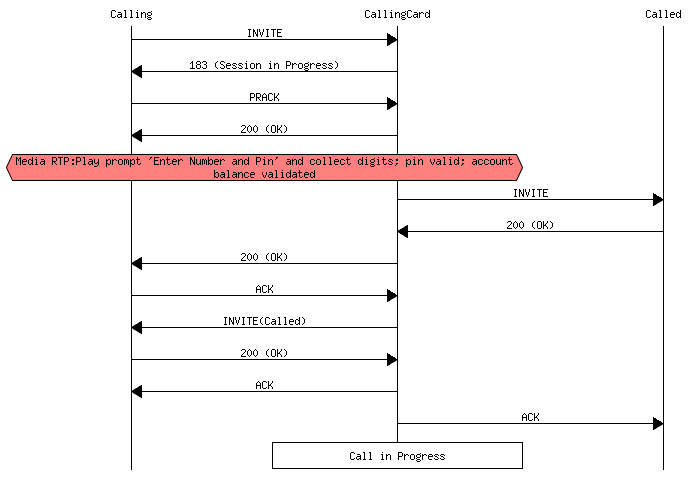
The following diagram shows the message exchange when the pin is valid, the account balance is validated, and the connection is successful.
SIP Call with Calling Party Ending the Call
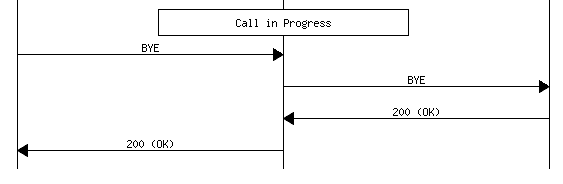
The following diagram shows the message exchange when the calling party terminates the call by hanging up.
SIP Call with Called Party Ending the Call
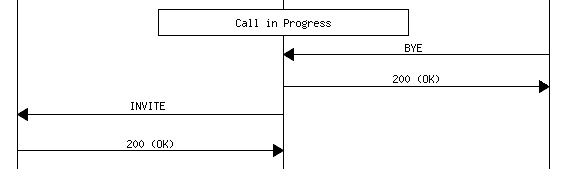
The following diagram shows the message exchange when the called party terminates the call by hanging up.
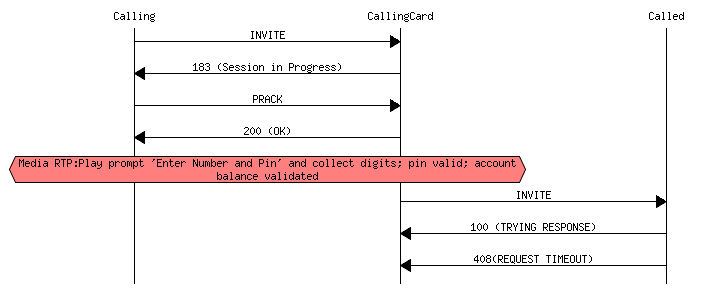
SIP Call with No Answer from Called Party
The following diagram shows the message exchange when the pin is valid, the account balance is validated, and the connection is attempted with no answer.
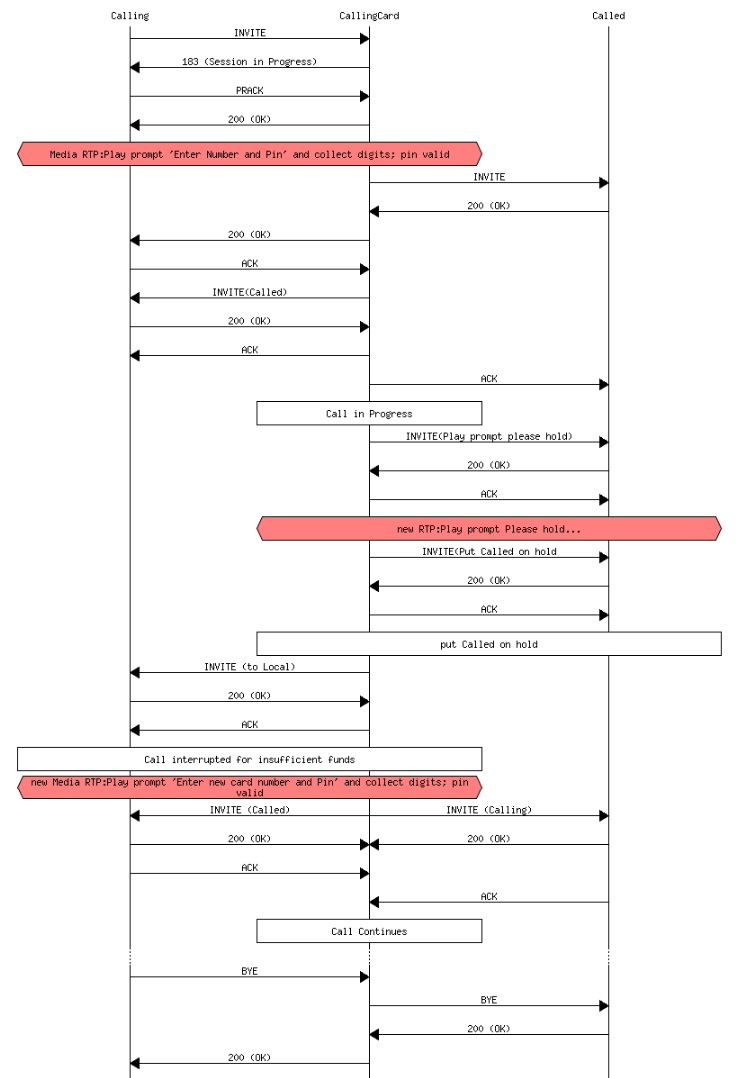
SIP Call with Insufficient Funds
The following diagram shows the message exchange when the calling party has insufficient funds for a call and enters a new account to continue the call.
SIP Call with Call to Third Party
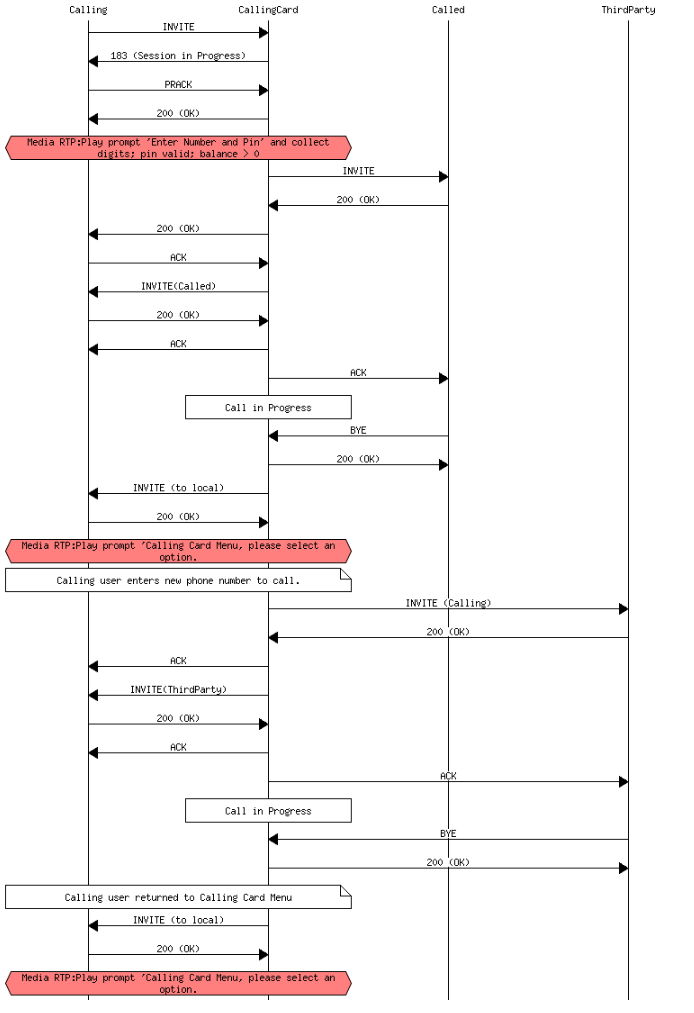
The following diagram shows the message exchange when the original called party terminates the call by hanging up, and the calling party initiates a call with a third party.